
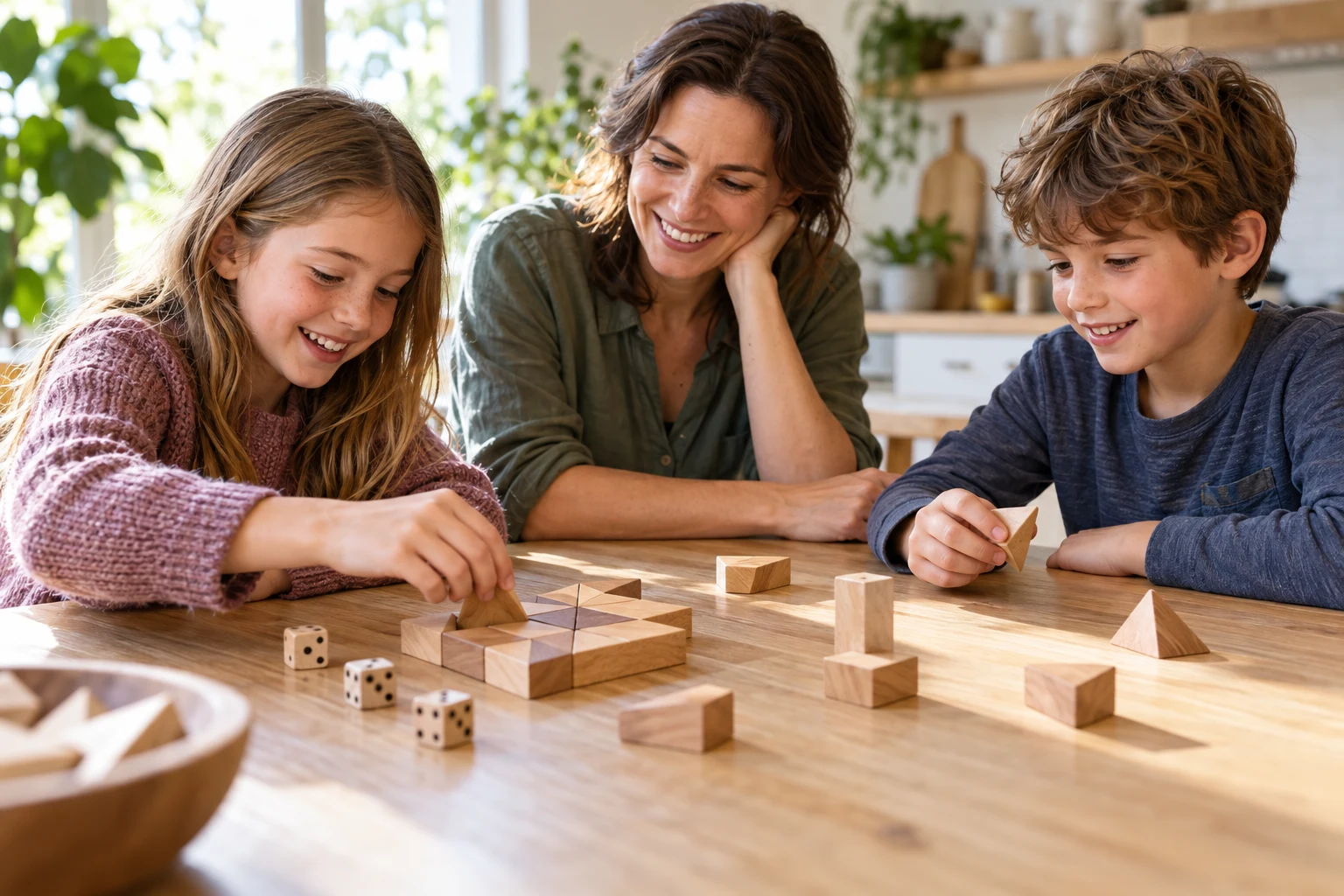
The best educational games for 9-year-olds give children a reason to think: finding a clever word, planning an escape route or working out which move earns the most points. The learning happens through playing, rather than through a worksheet disguised as a game.
This guide brings together ten screen-free choices for different interests, from spelling and mental maths to pattern recognition and spatial puzzles. There are options for independent play, quick after-school games and family evenings.
Affiliate disclosure: As an Amazon Associate I earn from qualifying purchases. This article contains affiliate links.
How we chose: This is a researched selection, not a hands-on product test. We checked publisher and manufacturer information where available, including recommended ages, game mechanics and player counts. The learning descriptions explain what children practise during play; they are not promises of improved school results. “Best for” labels are our editorial judgments.
Amazon links below lead to product searches so readers can compare editions and sellers. Prices and availability vary; check the product language, age guidance and contents before ordering.
At a glance
| Game | Best for | Recommended age | Players |
|---|---|---|---|
| Qwirkle | Family game nights | 6+ | 2–4 |
| Rush Hour | Independent logic puzzles | 8+ | 1 |
| Gravity Maze | Hands-on STEM puzzles | 8+ | 1 |
| BANANAGRAMS | Spelling and word building | 7+ | 1–8 |
| Math Dice | Confident young mathematicians | 8+ | Solo practice or group challenges |
| Kingdomino | Strategy and scoring | 8+ | 2–4 |
| Sleeping Queens | Playful arithmetic practice | 8+ | 2–5 |
| SET | Visual reasoning | 6+ | 1+ |
| Ticket to Ride | Maps and longer family games | 8+ | 2–5 |
| Blokus | Spatial thinking | 7+ | 2–4 |
Age recommendations are starting points. A child's reading confidence, patience and experience with games matter too.
1. Qwirkle — Best Educational Game for Family Nights

Image reference: Qwirkle.
Qwirkle uses tiles marked with different colours and shapes. Players build lines that share one feature while keeping the other different, then score their placements.
Its appeal for nine-year-olds is the gap between understanding the rules and finding a really good move. A child can make a valid line quickly, but choosing a placement that scores in several directions takes more thought.
What children practise: Classifying shapes and colours, spotting patterns, adding scores and considering future moves.
Why choose it: There is no need to read questions or spell words during play, making it a useful option when family members have different reading abilities.
Watch out for: It needs table space, and younger players may appreciate help keeping score.
2. ThinkFun Rush Hour — Best for Independent Problem-Solving

Image reference: Rush Hour.
In the classic Rush Hour puzzle, children slide blocking vehicles backwards and forwards until the red car can escape. The standard game includes 40 challenges with increasing difficulty.
The puzzle makes planning visible: moving one car may free another, which creates space for the move that actually matters. There is no opponent or race timer in the standard solo format.
What children practise: Sequencing, logical reasoning and revising an unsuccessful approach.
Why choose it: It is a strong choice for a child who enjoys solving something independently, with a clear goal and a satisfying finish.
Watch out for: Buy classic Rush Hour, rated 8+, rather than assuming Rush Hour Junior is the same product. Experienced puzzlers may eventually exhaust the supplied challenges.
Find ThinkFun Rush Hour on Amazon
3. ThinkFun Gravity Maze — Best for Hands-On STEM Puzzles

Image reference: Gravity Maze.
Gravity Maze asks children to arrange towers so a marble travels from its starting point to a target. Its 60 challenges combine construction with a specific problem to solve.
This is especially appealing for children who like building and testing. A failed marble run gives immediate feedback, encouraging another look at the route and the orientation of the pieces.
What children practise: Spatial reasoning, planning, testing and troubleshooting.
Why choose it: The physical result makes it easier to discuss why a design worked or failed.
Watch out for: It is a structured, single-player puzzle rather than a large, open-ended marble-run construction set. Keep its small marbles away from younger siblings.
4. BANANAGRAMS — Best for Spelling and Word Building

Image reference: BANANAGRAMS.
BANANAGRAMS uses letter tiles to build connected word grids. Players rearrange their own layouts as new letters arrive, so finding a better word can mean rethinking an entire section.
For a nine-year-old who already enjoys reading and spelling, it offers plenty to explore without needing a large game board.
What children practise: Spelling, recalling vocabulary and recognising alternative letter combinations.
Why choose it: The pouch travels easily, although playing still requires a flat surface.
Watch out for: Competitive speed can frustrate less confident spellers. An adult can introduce the tiles through relaxed, untimed word building before trying the standard race.
Find classic BANANAGRAMS on Amazon
5. ThinkFun Math Dice — Best for Children Who Enjoy Maths Challenges

Image reference: Math Dice.
In the original Math Dice game, two dice create a target through multiplication. Players then combine the numbers on three other dice using mathematical operations to get as close as possible to it.
Instead of answering a fixed list of sums, children investigate which calculations might work. That makes it a particularly interesting pick for a nine-year-old who likes experimenting with numbers.
What children practise: Mental arithmetic, multiplication and flexible use of operations.
Why choose it: The small set is easy to bring out for a short challenge.
Watch out for: The original game can be demanding for children still building confidence with basic arithmetic. Math Dice Jr. is a different, simpler product.
Find original ThinkFun Math Dice on Amazon
6. Kingdomino — Best for Strategy with Multiplication Practice

Image reference: Kingdomino.
Kingdomino turns domino-style tiles into a growing kingdom. Players connect matching landscapes and weigh up which tiles will make their territory more valuable.
Scoring provides a practical use for multiplication: the size of a connected terrain area is multiplied by the crowns within it. Children can see why expanding an area and adding crowns affect its value.
What children practise: Spatial planning, multiplication and comparing competing choices.
Why choose it: The publisher lists a play time of around 15 minutes, making it an approachable step into strategy games.
Watch out for: Adults may need to explain scoring during the first few games. Choose the original standalone Kingdomino rather than an expansion.
7. Sleeping Queens — Best for Arithmetic Hidden in a Card Game

Image reference: Sleeping Queens.
Sleeping Queens combines kings, queens, knights and dragons in a lively card game. Players wake queens and defend them while trying to collect enough queens or points to win.
Its useful maths feature is the option to discard number cards by making an addition equation. Spotting a valid combination gives arithmetic a purpose within the game.
What children practise: Addition, tracking points and deciding when to use special cards.
Why choose it: The fantasy theme gives children something to enjoy beyond the number work. The original game is rated 8+, for two to five players, with a listed playing time of about 20 minutes.
Watch out for: Queens can be stolen or put back to sleep. Children who dislike losing progress may prefer a solo puzzle.
Find the original Sleeping Queens on Amazon
8. SET — Best for Visual Reasoning

Image reference: SET.
SET challenges players to find groups of three cards. For each feature—colour, shape, number and shading—the cards must be either all alike or all different.
The rule sounds simple, but applying it across several features requires careful checking. It offers a substantial challenge without spelling questions or general-knowledge quizzes.
What children practise: Applying logical rules, comparing attributes and explaining why a group qualifies.
Why choose it: It works for solo searching as well as shared play.
Watch out for: Experienced players can dominate a speed-based game. Begin by finding and discussing sets together before introducing competition.
Find the original SET card game on Amazon
9. Ticket to Ride — Best for Maps and Family Strategy

Image reference: Ticket to Ride.
The original Ticket to Ride sends players across a map of North America, collecting train cards and claiming railway routes between cities. Destination tickets give each player connections to complete.
For nine-year-olds ready for a longer game, it combines an appealing travel theme with decisions about routes, resources and timing.
What children practise: Reading a game map, planning connections, counting and weighing risk.
Why choose it: The original game is rated 8+, supports two to five players and has a listed playing time of 30–60 minutes.
Watch out for: It takes longer than the other short family games here. Its map is a game representation, not a geography textbook. Ticket to Ride: First Journey is a simpler alternative for less experienced players.
Find the original Ticket to Ride on Amazon
10. Blokus — Best for Spatial Thinking

Image reference: Blokus.
Blokus gives players differently shaped pieces to fit onto a shared board. Pieces of the same colour connect at corners, creating a challenge around reaching open spaces while other players expand.
Children need to consider how a piece will fit now and whether placing it will preserve useful options later.
What children practise: Mentally rotating shapes, recognising spaces and planning ahead.
Why choose it: It provides a substantial thinking challenge with very little reading during play.
Watch out for: Blocking is central to the game, which can feel personal to sensitive players. Check that you are buying standard Blokus; versions such as Blokus Duo have different player arrangements.
Find standard Blokus on Amazon
How to Choose an Educational Game for a 9-Year-Old
Start with what your child already likes doing. A keen reader may enjoy BANANAGRAMS; a builder may prefer Gravity Maze. A child who dislikes timed competition could find Rush Hour more inviting than a word race.
Next, consider who will actually play. Solo puzzles are useful for independent time, while Qwirkle, Kingdomino and Ticket to Ride need willing opponents. A wonderful family game will get little use if nobody has time to join in.
Finally, choose one useful challenge. A game that asks a child to learn unfamiliar rules, read difficult text and calculate quickly all at once may be more frustrating than enjoyable.
Frequently Asked Questions
What is the best educational game for a 9-year-old?
Qwirkle is our first choice for a shared family game because it combines accessible rules with meaningful decisions. For independent play, start with Rush Hour. The best fit depends on your child's interests and confidence.
Which games are good for maths practice?
Math Dice offers the most direct arithmetic challenge. Kingdomino makes multiplication part of scoring, while Sleeping Queens includes addition within a playful card game.
Which educational games can children play alone?
Rush Hour and Gravity Maze are designed for one player. SET also supports solo play, and BANANAGRAMS can be used for independent word building.
Are these games screen-free?
Yes. The standard physical games listed here can be played without a phone, tablet or computer.
Our Pick: Start with One Game They Will Want to Play Again
For most families choosing a first game from this list, we would start with Qwirkle. For a child who prefers solving puzzles alone, choose Rush Hour. For spelling enthusiasts, try BANANAGRAMS.
Repeated play gives children opportunities to notice patterns, try different strategies and explain their decisions. Choose the game that makes them want another round.
Research sources
Researched 25 October 2026. Product details can change by edition and market.
- Qwirkle: https://www.mindware.orientaltrading.com/qwirkle-tile-matching-game-award-winning-strategy-game-for-family-game-night-a2-32016.fltr
- Rush Hour: https://www.ravensburger.co.uk/en-GB/products/games/brand-rush-hour
- Gravity Maze: https://www.ravensburger.us/en-US/pdp/76433
- BANANAGRAMS: https://www.amazon.com/Bananagrams-Fast-paced-spelling-portable-educational/dp/1932188126
- Math Dice: https://www.ravensburger.us/en-US/products/games/thinkfun/math-dice-44001510
- Kingdomino: https://www.blueorangegames.com/games/king-domino
- Sleeping Queens: https://www.gamewright.com/product/Sleeping-Queens
- SET: https://playmonster.com/product/set/
- Ticket to Ride: https://www.daysofwonder.com/game/ticket-to-ride/
- Blokus: https://www.ypc.co.uk/product/mattel-games-blokus-family-board-game-for-kids-and-adults-for-party-game-night-strategy-game-engaging-gift-for-kids-2-to-4-players-ages-7-and-up-bjv44/